
Cinevent Retrospective: Ruthless (1948)

We will be blogging about films that were shown at past Cinevent conventions until the Picture Show in May. This week we review a movie shown in 1992.

RODNEY BOWCOCK: Ruthless (1948) tells us the story of Horace Vendig (Zachary Scott), a merciless capitalist masquerading as a philanthropist (although, to be fair, those two things do often intersect, even, or especially today). The story is told via flashback as we witness scenes of his troubled childhood with an absent father and abusive mother. Horace saves the life of a young girl, showing signs of selflessness and is taken in by her wealthy family as a result. Instead of continuing this path, he allows greed to corrupt him. This film is tells the story of his rise and descent along with those that he has taken down with him.

SAMANTHA GLASSER: Even though the opening scene tells us that Horace is a bad person, I felt sorry for him and was rooting for him at first. He was dealt a bad hand in his childhood, but seemed to be a good person in spite of that. (He is also played by Robert Anderson who played young George Bailey in It’s A Wonderful Life, which tinges our feelings.) The first indication that he might embody the title quality is when he throws Martha over in spite of all her family has done for him to succeed.
RB: As the film progresses, we do see signs that Horace does have regrets about some things in his life, including this, but he is consistently able to push those feelings down as he relentlessly pursues his social and financial ambitions.
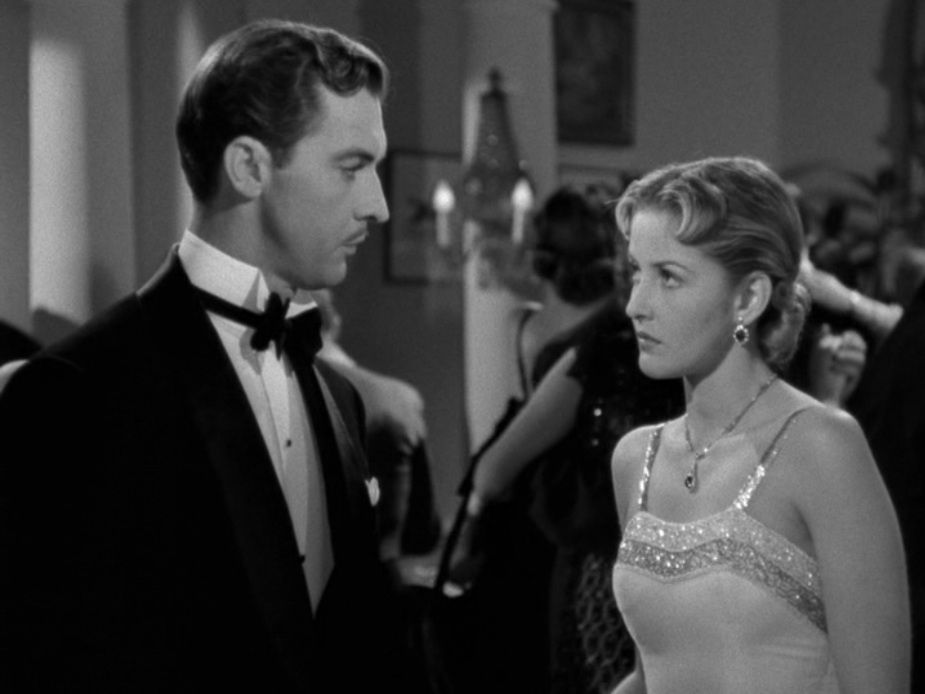
SG: I found Susan (Martha Vickers) to be well-cast as the more sophisticated and regal option in contrast with wholesome Martha (Diana Lynn), but Christa (Lucille Bremer) seemed to be a step down, except for her value to hurt his financial rival, which is all Horace really wanted from her.
RB: I like Martha Vickers, although it’s more than fair to say that she never fully lived up to her potential as an actress. Her famous appearance in The Big Sleep did seem to push her into a realm of roles that are credited at least but even this film is an indie attempt at taking a share of the market from the majors. For whatever reason, her star didn’t shine as brightly as it should’ve.
Diana Lynn fared much better, while maybe not a star, she did have major supporting roles throughout the 1950’s. She’s quite good in this, and like Vickers deserved better roles.

SG: All of the actors were too old to be playing the college-aged versions of the characters, but they were otherwise capable. Louis Hayward is one of those actors who naturally draws the eye without a lot of flash.
RB: At some point, I’ve kind of become desensitized that that whole thing, but you’re right. Even in 1948, none of these folks could actually pass for younger than their late 20’s.
SG: Raymond Burr has a small but memorable part as the conniving, bombastic father who abandoned his family.

RB: And he’s fantastic too, which is no real surprise to those of us who are familiar with his work. At this time, Burr was primarily a radio actor. This is one of his earlier film credits in a career far too lengthy and familiar to dig into here, but his appearance is a very very good one.
SG: According to director Ulmer, “There were three big sequences between Hayward and the youngster that were cut, and then two big sequences of Greenstreet and Zachary Scott. It was a dangerous script which had to be cut because McCarthy came in and it was written by Alvah Bessie.” Bessie didn’t get credit because he was blacklisted; made-up names S.K. Loren and G. Kahn grace the screen instead. Bessie’s work was an adaptation of a novel, Prelude to Night by Dayton Stoddart.
RB: This is likely the sort of story that wouldn’t have been touched by a major studio, but Eagle-Lion was an upstart built partially from the ashes of PRC. This was among their most ambitious releases but few were actually down in the ranks as the PRC product. Browsing the Eagle-Lion filmography is a fascinating look at an astounding variety of films starring actors on the way up, on the way down and in some cases near the peak of their abilities.

SG: Bert Glennon, who was nominated for an Oscar for his work on Stagecoach, was the cinematographer, and created a luminous look for the film. In one scene, Mallory’s face dissolves into that of young Martha. Ulmer called him a, “Cantankerous bastard, but a wonderful cameraman.”
RB: Some sources list this film as a noir, which I don’t particularly buy (but let’s not get into that again), but the one thing that is noirish is Glennon’s striking camera work. He really sets a mood throughout the entire film that in many cases becomes a part of the story, like only the best camerawork can.
SG: Photoplay raked the film over the coals. “A third-rate story of a first-rate heel, this over-pretentious picture has all the characters indulging in double talk… Apparently, Scott thinks that a stony stare suggests ruthlessness, for that’s practically the only expression on his masklike face throughout the story. Louis Hayward is more successful in his portrayal of Scott’s lifetime friend, reluctant to believe he’s a heartless scoundrel.”

Movieland’s reviewer represented the opposite end of the spectrum. “The authentic costumes of the twenties are sensational. Stand-out performances are turned in by the whole cast. The love scene between Buck and Christa will knock you for a loop. Everything about it adds up to a really splendid film.”
Harrison’s Reports said, “It can boast of good production values and of a cast whose names should be of help at the box-office, but these attributes are not enough to overcome a story that is not only unconvincing but made worse by a series of confusing flashbacks and by affected direction and acting. Moreover, its running time is unreasonably long and the action is slowed down considerably by too much talk.”
RB: Around 1950, Eagle-Lion was offering this film in 16mm in a 77 minute cut down, which I suspect could actually help the story. I agree that it’s a talky movie that overstays its welcome somewhat.
SG: I don't less; I want more. The ending leaves a lot to be desired. Some of the storylines weren’t completely resolved, even though it was suggested they might be.

Instead of being an uplifting tale of how a boy who had ever reason to fail in life gets his chance and succeeds, the movie seems to be an illustration of how ill-bred people become uncouth businessmen when given opportunity and education.
Mallory’s quip at the end doesn’t resolve anything and left me feeling confused.
RB: You really hit the nail on what bothers me the most about this film is that as the movie ends, I was left with too many questions and I didn’t expect it to be that kind of movie.
SG: This is a four-star movie with a two-star ending. I’ll settle for 3.5 stars.
RB: Ulmer is a fine director, but this film had too many imperfections for it to live up to its potential for me. I feel like it stalls out as a poor man’s Citizen Kane. There were things that I thought were exceptional, but overall when taking the warts into account, this is only a 3 star film for me.


Comments