
Jean Arthur August: If You Could Only Cook (1935)

Updated: Aug 5, 2025
There are some actors who seem to be great in everything they do without exception. This month we explore some of Jean Arthur’s lesser-known films to find out if she really was great in everything.

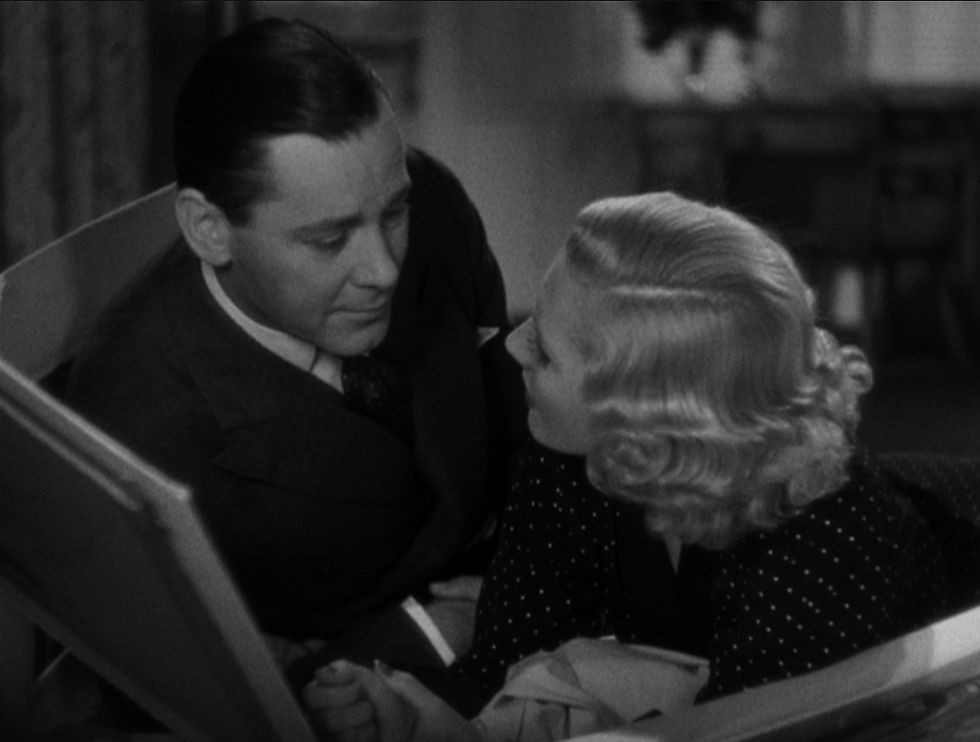
RODNEY BOWCOCK: Jim Buchanan (Herbert Marshall) is a pioneering head of an auto manufacturer. Sensing that the end of the Depression is coming soon, he optimistically predicts a boom that wouldn’t really begin in the country until after the war, and expects that consumers are ready to embrace new and futuristic auto designs. His board disagrees with his assessment. Dejected, Jim retreats to a park to consider his future plans and meets Joan Hawthorne (Jean Arthur) a working-class woman who is experiencing a bout of bad luck. Without revealing his good fortune to Joan, they strike up an acquaintance. Looking for work, Joan suggests to Jim that they pose as a married couple to get a job for a wealthy man as his butler and cook. What Joan doesn’t know is that Jim is engaged to be married in just a few days to Evelyn Fletcher (Frieda Inescort). Needing an escape from the responsibilities of his life, and, of course, because he is attracted to Joan, Jim agrees to this plan, finding employment in the home of a high-class former bootlegger and gangster Mike Rossini (Leo Carrillo).

SAMANTHA GLASSER: It is clear Jim doesn't want to get married, and the writers justify his straying on his sabbatical by giving his fiancée a side piece in the form of smarmy, mustachioed frequent-villain George Meeker.
RB: This plot wrinkle really helps you to never feel that Jim is a cad for stepping out on his fiancé. I never gave it a thought.
SG: In order to soothe any appearances of impropriety with the fake marrieds, they make Jim sleep on the porch.

RB: That’s post-code at its post-codiest. Rossini’s right-hand man (Lionel Stander) doesn’t really trust Jim and Joan and does a lot of snooping. He discovers the unorthodox sleeping arrangements, and when confronted with this peculiarity, Joan dismisses it as simply being where Jim likes to sleep.
SG: I imagine that scenario could have been indulged more, to be a quick switch in and out frantic comedy cover-up, but it is left alone. This film offers many genres all rolled into one, not all of them fully realized. It is a screwball comedy, a domestic romance, social commentary and a gangster picture which gives it a leg-up in quality, because each one is satisfyingly done.
RB: For a couple of reasons, this is not a film that’s spoken of with the great screwball comedies, like It Happened One Night and My Man Godfrey, perhaps because this isn’t a TRUE screwball comedy in the way that those films are because Joan is relatively grounded by comparison, but, I can’t disagree with you. It handles all of these aspects really well and in a really seamless manner.
SG: Arthur's star was on the rise. He success in 1935 gave her script and director approval at Columbia and soon she would begin her association with Frank Capra. Marshall was an established star who rarely got the chance to do comedy, and reviewers approved of his chemistry with Arthur. One said, his, "tendency for melancholia is so well concealed by Miss Jean Arthur's playing... that he takes on a new life as one of the debonair, heartthrob boys."

Director William Seiter praised his star, saying, "He'll work until he drops dead. Nothing is too much trouble for him. He never complains, is never difficult."
RB: This film was released in between Marshall’s work on The Dark Angel and The Lady Contests. I haven’t seen either of these films, but based on what I read about them, they seem quite typical of what you’d expect from Marshall’s work. Arthur was just about to appear in Mr. Deeds Goes To Town, which really would increase her profile.
If you know of Seiter today, you know that he was a great comedy director. His earliest efforts were directing silent comedy shorts. He later directed films for Wheeler & Woolsey, The Marx Brothers, Laurel & Hardy and Abbott & Costello and in the TV era directed over 50 episodes of The Gale Storm Show.

SG: One day during shooting, a bird found its way onto the sound stage and kept ruining takes by chirping. Several crew members tried for an hour to round it up with butterfly nets.
Lionel Stander is Carillo's henchman. He hailed from Brooklyn, NY where his father was a CPA. His brother became a doctor, but people assumed Lionel wouldn't amount to anything because he sporadically attended school and ran away from home often; he proved them wrong. He began in the theater, was a stand-in on Broadway, and got a break in radio with Fred Allen. His first screen appearances were in short comedies, which lead to feature work. He is outstanding in this film, impressive considering he'd only been in Hollywood four years. "I'm not going around draped in the responsibility of carrying a picture," he told an interviewer in 1936. "I was hired for comedy relief and comedy relief I'm going to be." Fun fact: the actor had heterochromia, which means his eyes were different colors.
RB: I admittedly was unaware of Stander until seeing this film, although I’ve definitely seen some of his work. He was super good and worked steadily through his death in 1994.
BUTLER: Fishing where, sir? JIM: You don't know. It's miles away from here, another world. I'm fishing for something I've been missing, fishing for a certain sort of happiness. BUTLER: Yes, sir. JIM: But don't tell them that. Tell them I've been fishing for fish.

SG: Harry Cohn at Columbia put Frank Capra's name in the credits in hopes of capitalizing on his success from It Happened One Night. Capra sued. It took three years, but the dispute was settled out of court. One of the conditions was that Cohn buy the rights to You Can't Take It With You for Capra.
RB: As I understand it, this was done specifically for European release. Perhaps Cohn gambled that Capra wouldn’t see the promotional materials? Either way, this seems like a reckless move even for Harry Cohn.
SG: Apparently, he tried to schmooze Capra and feed his ego to get away with it, but the tactic didn't work.
At the RKO Paramount in Cincinnati, the ushers, doormen and cashiers wore chef's costumes during the run of the film.
RB: An odd tie-in considering the lack of chefs in the movie!
SG: General Electric paired with distributors and advertisers to promote their products in association with this film.
RB: It’s fascinating to think about how luxurious all of those appliances must’ve seemed in Depression-era America.
SG: There are some celebrity-endorsed shorts from this era, including one with Dick Powell and Bette Davis, which advertise new gadgets from GE and they're fascinating to watch. Some of the ideas seem useful for a modern kitchen, and some seem odd for the sake of odd.

A. N. Miles of the Eminence Theatre in Eminence, Kentucky said, "These stars do not draw, but the picture is very, very good."
Photoplay called it, "One of those charmingly preposterous little Cinderella masquerade tales with Herbert Marshall's disarming manner and Jean Arthur's honest art to make it delightful watching."
This is a sparkling movie that tends to slip through the cracks when historian discuss screwball comedies and the careers of the stars, but it deserves to be rediscovered. Four stars.
RB: I didn’t know much about this movie going into it and had a thoroughly pleasant time watching it. It’s briskly paced and sharply acted. Four stars.


Comments